

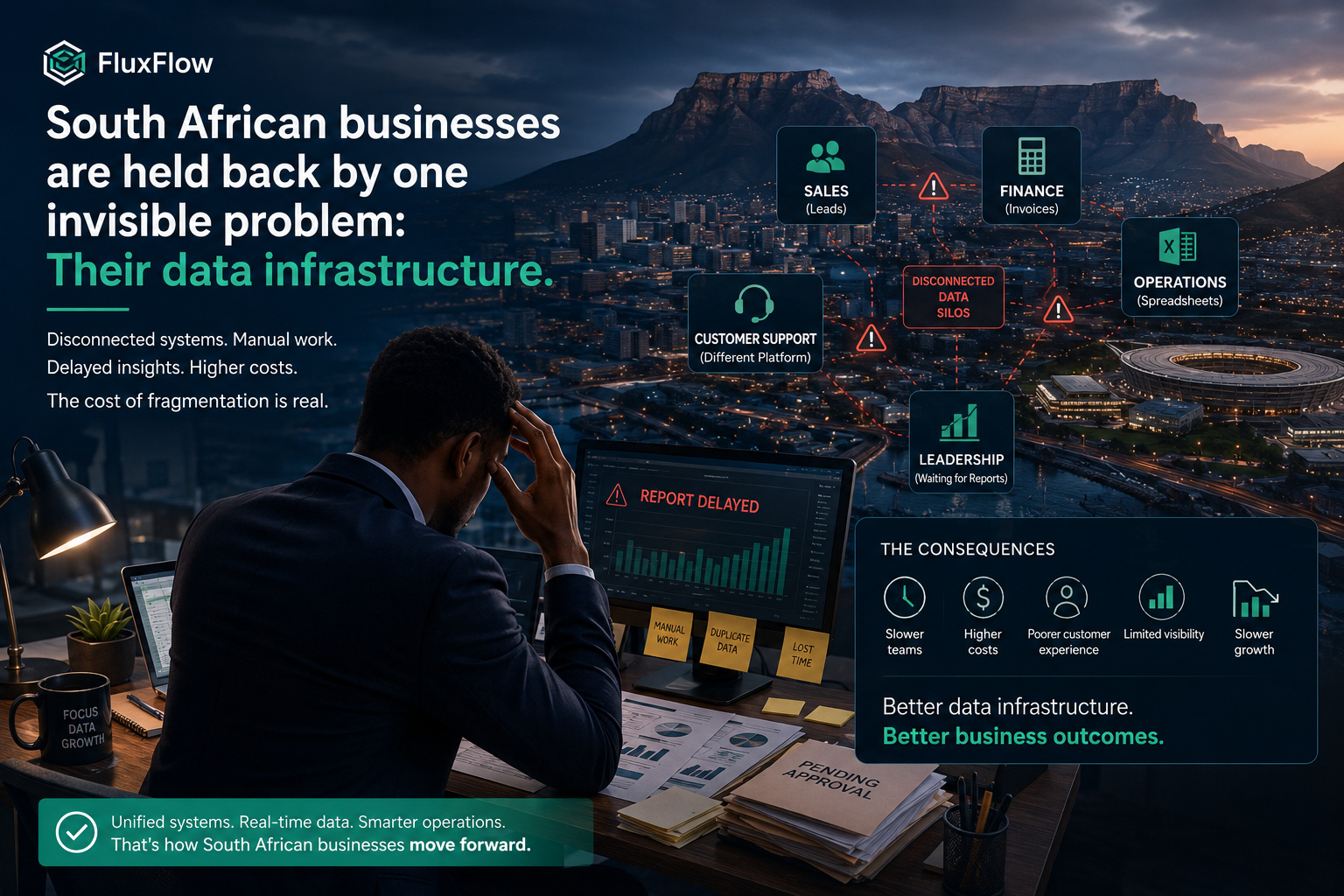
Why South African Businesses Are Losing Time and Money to Broken Data Infrastructure in 2026
Explore the biggest South African data infrastructure pain points in 2026 — from load shedding disruptions to disconnected systems — and how businesses can modernize operations with automation and centralized data.
South African businesses have adapted to almost everything.
Load shedding. Economic pressure. Connectivity instability. Rising operational costs. Hybrid work. Global competition.
Yet despite all this resilience, many companies are still being slowed down by one invisible problem:
Their data infrastructure.
Behind the scenes, countless businesses across South Africa are operating with disconnected platforms, duplicated admin work, manual reporting, and outdated workflows that cost time every single day.
The issue is not always obvious at first.
A sales team updates leads in one system. Finance captures the same information somewhere else. Operations rely on spreadsheets. Customer support uses a completely different platform. Leadership waits days for reports that should take minutes.
The result?
Teams work harder but move slower.
The Real Cost of Fragmented Systems
Most operational inefficiencies do not look dramatic.
They show up quietly.
A missed follow-up email. A duplicated invoice. A delayed approval. A client waiting too long for an update. A staff member manually copying information between systems.
Individually, these seem small.
Collectively, they become a major business problem.
Many South African companies are still relying on:
· Multiple disconnected software platforms
· Spreadsheet-heavy workflows
· Manual approval chains
· Email-based operations
· Inconsistent customer data
· Legacy systems that do not communicate with each other
When systems are fragmented, decision-making slows down.
Leaders cannot access real-time visibility. Teams spend more time fixing errors. Customers experience delays. Growth becomes harder to sustain.
In a market where responsiveness matters, operational friction becomes expensive.

Why This Problem Is Growing in South Africa
Digital adoption accelerated rapidly over the past few years.
Businesses adopted tools quickly to survive changing market conditions.
But many organizations implemented software reactively rather than strategically.
Instead of building integrated ecosystems, companies added tools one at a time.
The result is a patchwork of systems that were never designed to work together.
This creates several uniquely South African operational challenges:
1. Connectivity and Infrastructure Instability
When internet reliability or power interruptions occur, businesses with poorly integrated systems suffer more downtime.
Employees waste valuable time reconnecting workflows manually.
Without centralized automation, operations become highly dependent on human intervention.
2. Growing Administrative Overload
South African SMEs often operate with lean teams.
When staff spend hours on repetitive admin instead of strategic work, productivity suffers significantly.
Manual processes create bottlenecks that prevent teams from scaling efficiently.
3. Lack of Real-Time Visibility
Many business leaders still wait until month-end to understand performance.
Disconnected systems delay reporting and create uncertainty around:
· Sales performance
· Customer retention
· Operational bottlenecks
· Staff productivity
· Financial forecasting
In modern business, delayed visibility equals delayed decision-making.
4. Customer Experience Breakdown
Today’s customers expect fast, seamless communication.
But fragmented systems create inconsistent experiences.
A customer may need to repeat information multiple times because departments are not connected.
Slow internal processes become visible externally.
And when customer trust declines, growth slows.

Why Automation Is No Longer Optional
Automation is often misunderstood.
Many businesses assume automation means replacing people.
In reality, effective automation removes repetitive work so teams can focus on higher-value tasks.
The goal is not fewer people.
The goal is fewer operational bottlenecks.
Smart businesses across South Africa are now investing in:
· Centralized CRM systems
· Workflow automation
· Integrated reporting dashboards
· Automated lead management
· Cross-platform synchronization
· Cloud-based operational infrastructure
When systems communicate properly, businesses gain:
· Faster turnaround times
· Improved reporting accuracy
· Better customer experiences
· Reduced administrative load
· Stronger scalability
· More operational clarity
The Shift from Survival to Scalability
For years, many businesses focused on survival.
Now the conversation is changing.
Companies are asking:
“How do we scale without burning out our teams?”
The answer is rarely “work harder.”
It is usually:
“Build smarter systems.”
Modern businesses need infrastructure that supports growth instead of slowing it down.
That means moving beyond isolated tools and building connected ecosystems where information flows automatically.

What Modern Operational Infrastructure Looks Like
A strong business infrastructure today should:
· Centralize customer and operational data
· Automate repetitive administrative tasks
· Provide real-time visibility across departments
· Reduce human error
· Improve communication between teams
· Scale alongside business growth
The businesses winning in 2026 are not necessarily the largest.
They are the most operationally aligned.
South African businesses are incredibly resilient.
But resilience alone is no longer enough.
The companies positioned for long-term growth are the ones investing in operational efficiency, connected systems, and intelligent automation.
Broken data infrastructure does not only create inconvenience.
It quietly impacts revenue, customer experience, staff productivity, and scalability.
Businesses that modernize now will gain a significant competitive advantage over the next few years.
The future belongs to organizations that can move faster, operate smarter, and make decisions with clarity.
That starts with fixing the systems behind the scenes.

Ready to simplify your operations and eliminate disconnected systems?
FluxFlow helps South African businesses automate workflows, centralize data, and build scalable operational infrastructure.
Book a discovery call with FluxFlow today.